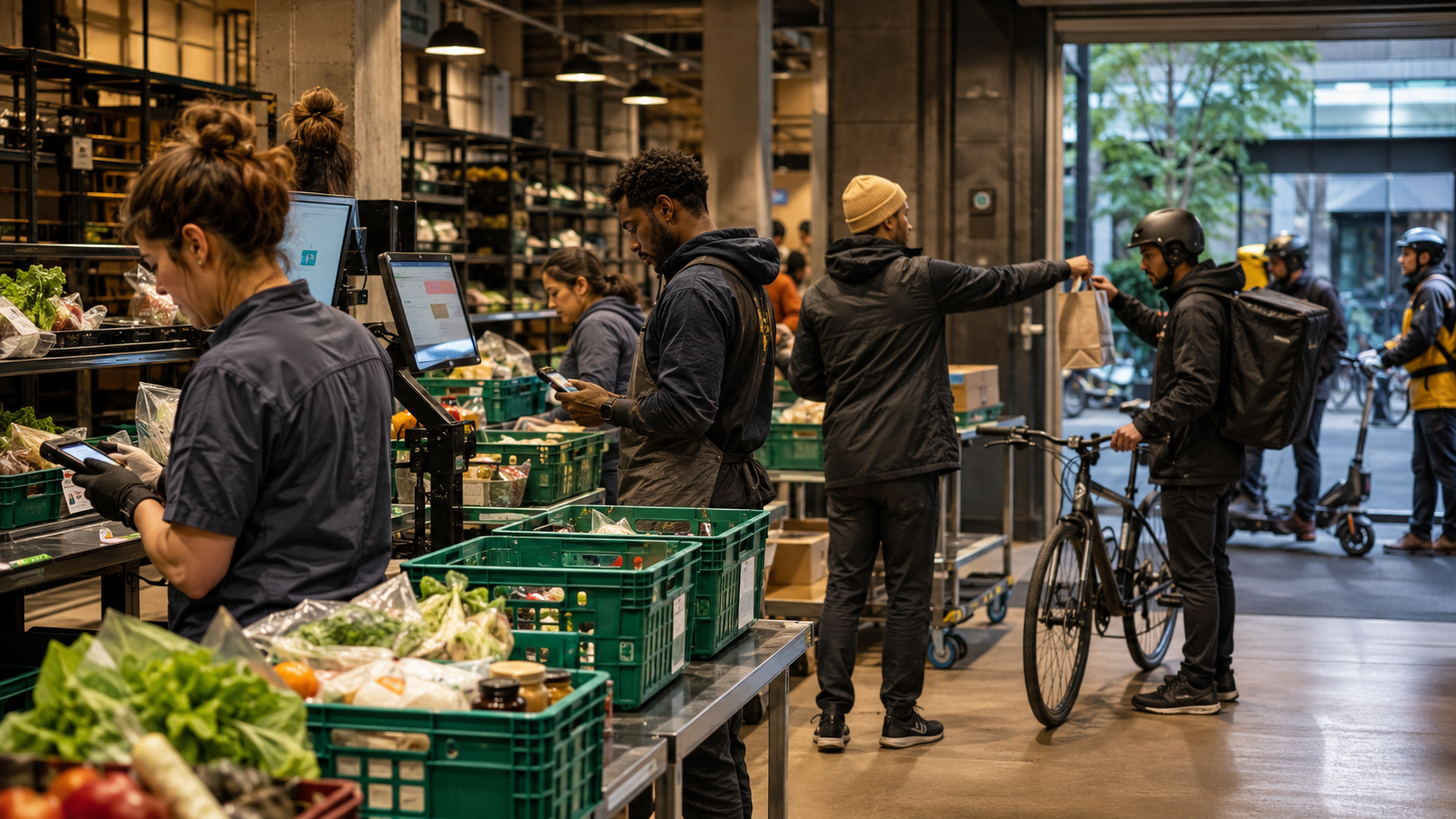
A promise of delivery in thirty minutes looks simple on a checkout screen. Behind it sits a tightly connected operating system: inventory must be close enough, the item must truly be available, a picker must find it quickly, an order must be packed correctly, and a courier must leave with a realistic route. One weak link can consume the entire promise.
This is why ultra-fast delivery should not be treated as a countdown imposed on warehouse and delivery teams. It is an operating-model choice that affects assortment, network design, product rules, labor planning, data quality, and customer communication.
The market is making that choice more visible. On 28 May 2026, Walmart said its thirty-minute-or-less service had expanded across 33 US markets and covered more than 100,000 eligible items. Amazon, meanwhile, has been expanding sub-same-day fulfillment and, according to reporting on 29 August 2026, introduced a bidding mechanism through which participating third-party sellers can seek eligibility for faster delivery. The details differ, but both developments show that speed is becoming a product tier—and an economic decision.
The clock starts long before checkout
Customers experience the delivery clock after pressing “buy.” Operations experience it much earlier.
The first decision is where inventory sits. A product held in a distant regional warehouse cannot become a thirty-minute item through a better courier app. Fast promises generally require inventory positioned close to demand: in stores, micro-fulfillment facilities, urban hubs, or a distributed network. That proximity reduces travel time but creates a different cost. More locations can mean fragmented stock, duplicated safety inventory, more replenishment movements, and greater exposure to local forecast error.
The second decision is which products qualify. A catalog may contain thousands of items, but not all of them deserve the same promise. Fast-moving essentials with stable demand behave differently from bulky, fragile, regulated, or rarely purchased items. A disciplined service defines an eligible assortment using demand density, handling time, margin, substitution risk, storage constraints, and local availability.
This is product management applied to physical flow. The service is not “everything, immediately.” It is a carefully designed promise for the right order, location, and moment.
Inventory accuracy becomes customer experience
In conventional delivery, an inventory discrepancy might be discovered with enough time to source a replacement. In a thirty-minute journey, the same discrepancy becomes an immediate customer failure.
The system may say that the final unit is on a shelf even though it is in another shopper’s cart, damaged, misplaced, awaiting a stock adjustment, or already reserved by another digital order. Every delay spent searching reduces the remaining time for packing and transport.
That makes inventory confidence as important as inventory quantity. A useful availability engine should consider more than the recorded on-hand balance. It may need reservations, recent sales velocity, replenishment status, shrink patterns, shelf-location confidence, and a safety buffer. The exact rule depends on the business, but the principle is consistent: do not sell a speed promise using inventory data that cannot support it.
Teams should measure false availability separately from ordinary out-of-stock rates. They should also track where the discrepancy is discovered—at allocation, picking, packing, or customer handover. That distinction turns a generic service failure into a process-improvement opportunity.
Speed needs protected capacity
An express order competes with store shoppers, scheduled deliveries, regular e-commerce orders, replenishment work, and other operational priorities. If every urgent order simply jumps the queue, the service may improve one metric while damaging several others.
Protected capacity is therefore part of the design. It can take the form of dedicated pick zones, limited express slots, dynamic order throttling, separate dispatch staging, or a small team assigned during peak periods. The right arrangement depends on demand volume and facility layout.
Capacity should also be promised dynamically. A customer five minutes away at a quiet hour presents a different risk from a customer at the edge of the service area during rain and peak traffic. A credible system combines current picking backlog, staffing, item location, courier supply, distance, and travel conditions before offering the service level.
The objective is not to show the fastest possible number. It is to show the fastest promise the operation can keep.
Exception design matters more when time is compressed
Fast flows do not eliminate exceptions; they shorten the time available to resolve them. An item may be missing, payment may require review, a courier may cancel, an address may be incomplete, or a building may be difficult to access.
Each predictable exception needs a decision path. Can a substitute be selected automatically within agreed preferences? Should the order split, downgrade to standard delivery, or be cancelled? At what point should the customer be notified? Who has authority to issue a credit? Which cases require a human, and how quickly must that person respond?
A simple exception matrix can be more valuable than another dashboard. For every high-frequency failure, define the trigger, owner, permitted action, customer message, and recovery target. Then test those paths during realistic peaks, not only in a quiet pilot.
This is also where humane operations matter. A system should not convert every forecast error or product defect into pressure on a picker or courier to take unsafe shortcuts. If the promised time is already impossible, the product should degrade honestly rather than transfer the risk to a person on the road.
Measure the promise end to end
On-time delivery is necessary, but it is not enough. A thirty-minute order that arrives with the wrong product, a poor substitution, damaged goods, or a stressed worker is not a successful outcome.
A balanced scorecard can include:
- promise acceptance rate: how often the service is offered when requested;
- perfect-order rate: on time, complete, accurate, and undamaged;
- inventory-confidence failures and search time;
- pick, pack, wait, and travel time as separate stages;
- substitution acceptance and cancellation rates;
- cost and contribution per completed express order;
- courier and picker safety indicators; and
- repeat usage and customer complaints.
Segmenting these metrics by location, daypart, order profile, and delivery radius helps teams see whether the operating model is genuinely scalable or only successful in favorable conditions.
The promise should have an off-ramp
One of the strongest product decisions is knowing when not to offer speed. During severe weather, unexpected demand, system degradation, or constrained courier supply, the responsible option may be a longer window.
An off-ramp is not a failure of ambition. It protects reliability. Customers can make a reasonable choice when they receive an honest estimate. They lose trust when an aggressive promise quietly becomes a late order.
Fast delivery will continue to attract attention because it turns logistics into an immediate customer experience. But the organizations that sustain it will not win by asking every person to move faster. They will win by redesigning the system around proximity, dependable inventory, protected capacity, clear exceptions, and promises that respond to reality.
The stopwatch is the visible part. The operating model is the product.
**Discussion:** In your operation, which constraint would break a thirty-minute promise first: inventory accuracy, picking capacity, courier availability, or exception handling?
Sources
- [Walmart — 30-minute-or-less delivery across 33 US markets, 28 May 2026](https://corporate.walmart.com/news/2026/05/28/walmart-brings-30-minute-or-less-delivery-to-33-us-markets)
- [Business Insider — Amazon asks sellers to bid for faster shipping, 29 August 2026](https://www.businessinsider.com/amazon-third-party-sellers-bid-faster-shipping-2026-8)