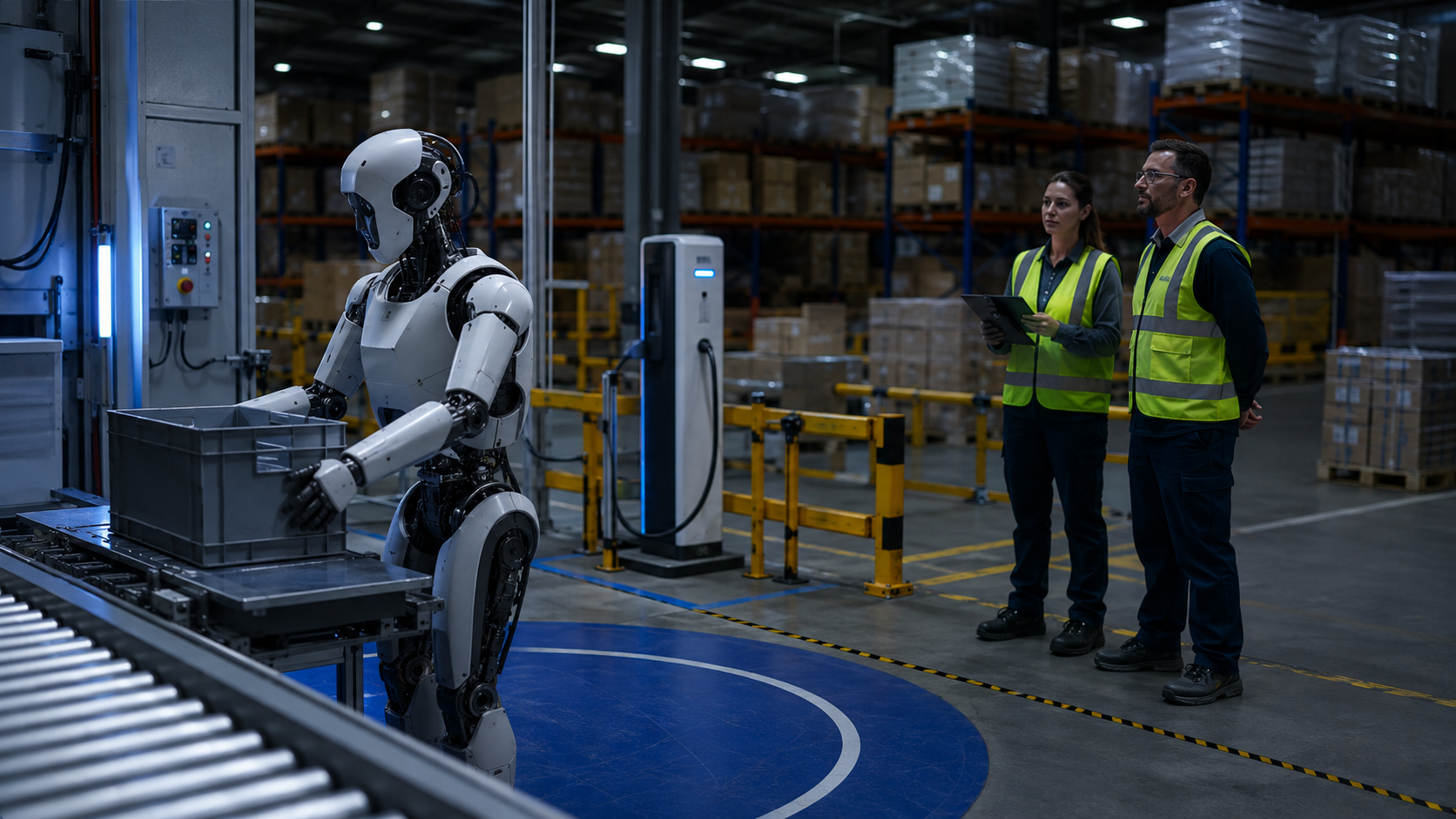
A humanoid robot can win the internet in fifteen seconds. A warehouse has to perform for every shift.
That difference is easy to forget when a machine runs, jumps, folds a shirt, or carries a box in a polished video. In August 2026, attention accelerated again: Reuters reported on 24 August that Xpeng’s robotics unit had raised more than $900 million in its first funding round, valuing the unit above $6.3 billion. The money is intended for hardware, software, physical-AI models, data, mass-production facilities, and global expansion.
The excitement is understandable. A human-shaped machine suggests a powerful promise: instead of redesigning buildings, racks, tools, and workstations for automation, perhaps we can send a robot into an environment already designed for people.
But a warehouse is an unforgiving place to test a promise. Throughput, safety, uptime, travel distance, battery management, SKU variation, peak periods, and system integration all meet on the same floor. A robot that performs one task in a controlled demonstration is not yet an operational solution.
From my perspective across warehouse operations, logistics, product, and enterprise systems, the right question is not, “Can the robot do the movement?” It is, “Can the full operating system absorb the robot and still deliver a better outcome?”
The human form solves one problem and creates others
Warehouses were built around human reach, human tools, stairs, handles, and flexible movement. That gives humanoid robots a theoretical advantage. A bipedal machine with arms and hands could operate in brownfield facilities where fixed automation is expensive or physically difficult to install.
Yet the human form is mechanically demanding. Balance, dexterous grasping, perception, and safe movement near people must work together. Every joint adds complexity. A wheeled autonomous mobile robot may be less impressive, but wheels are efficient on a flat warehouse floor. A robotic arm in a fixed cell may handle a narrow task faster and more reliably. A conveyor does not need to understand the room.
This is why form should follow the process. If the requirement is to move standardized totes along predictable routes, a humanoid may be unnecessary. If the requirement involves stairs, irregular spaces, existing hand tools, and multiple low-volume tasks, a human-like platform may eventually make more sense.
The expensive mistake is choosing the most general-looking machine before defining the operational problem.
Viral capability is not warehouse readiness
An operations team should separate four kinds of evidence.
The first is **demonstration evidence**: the robot completed a task once under prepared conditions. This proves possibility.
The second is **pilot evidence**: the robot repeated the task inside a limited real environment with supervision. This begins to reveal failure modes.
The third is **production evidence**: the robot met safety, quality, throughput, and uptime targets across normal shifts and realistic variation.
The fourth is **economic evidence**: the deployment produced enough value over its full lifecycle to justify capital, integration, maintenance, energy, training, spare parts, insurance, and operational disruption.
These layers are often collapsed in public discussion. A successful demo becomes “ready for deployment”; a signed pilot becomes “adoption”; a funding round becomes proof of demand. They are meaningful signals, but they do not answer the same question.
Gartner offered a sharp counterweight to the hype in January 2026. It predicted that through 2028 fewer than 100 companies would move humanoid proofs of concept beyond experimentation, and fewer than 20 would reach live production in supply-chain or manufacturing use cases. Its conclusion was not that robotics would fail, but that polyfunctional robots—machines designed for multiple tasks without necessarily copying the human body—could win more practical warehouse work in the near term.
A warehouse pilot needs a scorecard before it needs a robot
Suppose a distribution centre is evaluating a humanoid robot for depalletizing mixed cartons and feeding them into a sortation process. Before selecting a vendor, the team should establish a baseline.
How many cartons per hour does the current process handle? What is the range of weight, dimensions, packaging strength, and surface condition? How often do cartons arrive crushed or wet? How much space is available? What happens during peak volume? Which injuries or ergonomic risks are we trying to reduce? How many minutes of downtime can the process tolerate?
The pilot scorecard should then include at least six dimensions.
**Safety:** near misses, safe-stop behavior, collision risk, load drops, and recovery procedures.
**Performance:** sustained throughput, not the best five-minute run.
**Quality:** damage, mis-sorts, incomplete picks, and exception frequency.
**Reliability:** uptime, mean time between interventions, recovery after faults, and battery availability.
**Integration:** connection with WMS, WES, sensors, task queues, identity management, and operational reporting.
**Economics:** total cost per completed unit, including people who supervise, maintain, rescue, or rework the process.
One more metric matters: **operational flexibility**. A robot may be technically successful yet create a rigid bottleneck. If operators must standardize every carton, isolate a large safety zone, or pause adjacent work whenever the robot fails, the automation may shift cost instead of removing it.
Integration is where robotics becomes a product problem
A robot does not wake up knowing which order matters most. It needs tasks, priorities, locations, inventory status, and permission to act. That information typically lives across warehouse management, execution, labor, maintenance, and safety systems.
This turns the deployment into more than an equipment purchase. It becomes a product and process transformation.
The team needs exception flows for blocked aisles, missing inventory, unreadable labels, damaged packaging, depleted batteries, lost connectivity, and emergency stops. It needs a clear operating model: who owns the robot’s queue, who may override it, who investigates repeated failure, and when work returns to a human.
Data quality becomes physical. A wrong location in a database is no longer only a reporting issue; it can send a machine to the wrong place. A delayed inventory update can cause unnecessary travel or a failed pick. Poor master data becomes motion, waiting, and risk.
The future warehouse may be robot-centric without being humanoid
The broader automation direction is real. The International Federation of Robotics reported in January 2026 that the global market value of industrial robot installations had reached a record $16.7 billion. In April, Gartner predicted that by 2030 half of new warehouses in developed markets would be designed as robot-centric facilities where humans are optional.
Neither finding means every warehouse will fill with human-shaped machines. The more likely near-term picture is mixed: conveyors for stable flows, autonomous mobile robots for transport, vision systems for inspection, robotic arms for repetitive handling, specialized or polyfunctional robots for several related tasks, and people for ambiguity, recovery, judgment, and change.
Humanoids may earn a place in that mix. Their strongest opportunity could be in facilities that cannot be rebuilt easily and in work where human-compatible tools matter. But their success should be measured in uneventful shifts, not spectacular clips.
The best warehouse technology is often almost boring. It starts reliably, integrates cleanly, fails safely, is understandable to operators, and improves the flow without demanding constant attention.
Capital and viral interest can accelerate development. They cannot replace process analysis. Before asking whether a humanoid robot is the future, map the work, quantify the pain, compare simpler alternatives, and define what production success means.
The robot should enter the business case last—not first.
**Discussion:** Which warehouse task would genuinely benefit from a human-shaped robot, and which would be better solved by a simpler machine?
Sources
- [Reuters — Xpeng robotics unit valued above $6.3 billion after funding round (24 August 2026)](https://www.reuters.com/business/retail-consumer/xpeng-says-its-robotics-business-raised-over-900-million-first-funding-round-2026-08-24/)
- [Gartner — Humanoid robots expected to stall at pilot scale through 2028 (21 January 2026)](https://www.gartner.com/en/newsroom/press-releases/2026-01-21-gartner-predicts-fewer-than-20-companies-will-scale-humanoid-robots-for-manufacturing-and-supply-chain-to-production-stage-by-2028)
- [International Federation of Robotics — Top 5 Global Robotics Trends 2026 (8 January 2026)](https://ifr.org/ifr-press-releases/news/top-5-global-robotics-trends-2026)
- [Gartner — Half of new warehouses in developed markets predicted to be human-optional by 2030 (13 April 2026)](https://www.gartner.com/en/newsroom/2026-04-13-gartner-predicts-half-of-new-warehouses-built-in-developed-markets-will-be-human-optional-facilities-by-2030)